Why Procurement Leaders Are Prioritising Supply Chain Resilience Over Cost
Last year, a procurement team mid-execution on a strategic sourcing pipeline for their top ten complementary medicines ingredients watched their twelve-month plan unravel in real time. Geopolitical tensions destabilised a key supplier region. Lead times doubled almost overnight. Freight costs became untethered from any model they had built.
The original procurement strategy consolidating spend to unlock cost efficiencies had made sense in the environment it was designed for.
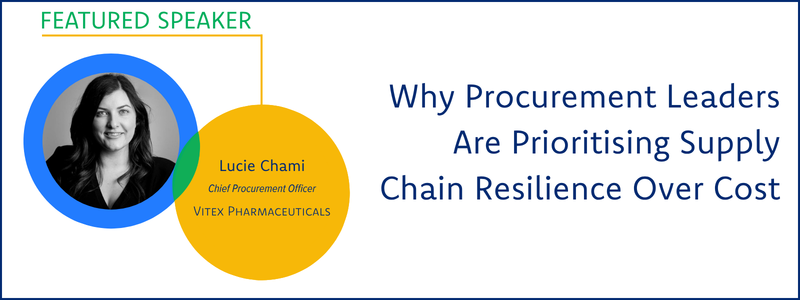
In a recent conversation, Lucie Chami, Chief Procurement Officer at Vitex Pharmaceuticals, shared how this shift is playing out in practice. Leading procurement for a complementary medicines manufacturer dependent on globally distributed ingredient supply, she has had to rethink how sourcing strategies balance cost, resilience and speed in a far less predictable environment.
“Procurement strategies must prioritise optionality and adaptability, not just efficiency.”
This is not a cautionary tale about a single difficult quarter. For Australian manufacturers operating in globally distributed supply chains, it is increasingly the baseline condition. Disruptions thousands of kilometres away geopolitical, logistical, or climatic can translate into production risk faster than most sourcing models can adapt.
The question is no longer whether your supply chain will face stress. It is whether your procurement strategy was built to absorb it.
The response in this case was a deliberate pivot: from cost optimisation to supply chain resilience. Secondary suppliers were rapidly qualified in alternative regions. Safety stock was increased for high-risk SKUs. In-flight contracts were renegotiated to embed greater flexibility.
The shift came with margin pressure. It also maintained supply continuity which, in volatile markets, is worth considerably more than the rebate it replaced.
Supply Chain Resilience vs. Cost: How Australian CPOs Are Making the Case Internally
Making the call to prioritise resilience over lowest cost is the easier part of this shift. Operationalising it and holding the organisation to it is where most procurement leaders encounter resistance.
Every trade-off creates winners and losers. A decision to diversify the supplier base and carry more safety stock will trigger concern from finance around margin pressure. A move to prioritise speed over process rigour may raise flags with compliance.
These tensions are legitimate. In practice, the pivot from cost to resilience gains traction with the CFO not through advocacy for procurement theory, but through a different kind of modelling. Once the procurement team maps potential supply disruption against production schedules, service level commitments, and customer revenue — not in the abstract, but as a concrete scenario — the conversation shifts.
Finance can price a rebate. It is considerably harder to price a stockout, a delayed product launch, or a customer relationship that does not survive a six-week availability gap.
“Maintaining cross-functional commitment requires more than agreement in principle — it demands transparent communication, a clear articulation of decision rationale, and reinforced metrics that anchor everyone to the chosen priority.”
The organisations navigating this most effectively have done one thing consistently: they adjusted their KPIs. Not to eliminate cost accountability, but to balance it. Teams are measured not just on savings delivered, but on supplier reliability, supply continuity, and risk reduction.
When the scorecard changes, behaviour follows. When the scorecard does not change, the resilience strategy erodes within a quarter as teams optimise for what they are being measured on.
Strategic Sourcing in Australia: The Dual-Supply Model as Competitive Advantage
The operational response to this environment is not to retreat from strategic supplier relationships, but to design supplier networks that strengthen supply chain resilience.
The model proving most effective is a structured dual-supply approach. A select group of top-tier partners receive greater volume, joint planning, and long-term commitments, supported by stronger commercial terms, pricing protections, and service-level guarantees that buffer against volatility.
Crucially, these partners are not simply executing orders. They provide early risk signals, supply outlook visibility, and mitigation options that allow procurement teams to act before disruptions escalate.
Alongside these strategic partnerships, disciplined procurement functions maintain qualified secondary suppliers: validated specifications, approved materials, commercially viable cost structures, and contractual flexibilities such as surge capacity or dual-sourcing clauses.
These are not theoretical backups. They are active relationships ready to absorb volume when needed.

For procurement teams operating from Australia — often several shipping weeks removed from major supplier regions — this architecture is essential. Geographic distance amplifies the cost of a single point of failure.
The dual-supply model addresses that reality: preserving the commercial advantage of deep supplier relationships while ensuring the organisation is never overexposed to one supplier, one region, or one logistics corridor.
“Consolidation has reduced operational noise. Fewer suppliers to manage means faster communication, tighter performance monitoring, and greater ability to execute contingency plans when market conditions shift.”
Ethical Sourcing in Australia: Compliance, Modern Slavery, and the Licence to Operate
There is a version of the resilience-first argument that becomes an excuse for cutting corners — moving quickly, qualifying suppliers loosely, and revisiting compliance later.
The most sophisticated procurement leaders draw a clear line against this.
The guardrails are non-negotiable: ethical sourcing, supplier qualification, labour practice transparency, environmental responsibility, product traceability, and financial integrity. These standards are embedded into supplier qualification before commercial evaluation begins.
A supplier that cannot demonstrate ethical alignment or meet compliance thresholds is not considered, regardless of commercial attractiveness.
This is not an abstract commitment. In practice, it means walking away from suppliers who fail to meet the standard.

In one instance, a prospective supplier offering strong commercial value could not demonstrate adequate labour practice transparency during an on-site audit. Missing documentation and inconsistent statements around subcontractor oversight created unacceptable risk. In another case, a technically capable supplier was disqualified after repeatedly failing quality system checks.
In both situations, the decision was to exit early rather than manage the risk downstream.
For Australian organisations, this stance is reinforced by regulatory pressure. The Australian Modern Slavery Act requires organisations to report on the risks of modern slavery in their operations and supply chains. ESG disclosure expectations continue to tighten, and investor scrutiny of supply chain ethics is intensifying.
Ethical sourcing is no longer simply a values statement. It is a licence to operate.
“Guardrails create integrity and safety. Judgement creates agility. By holding firm on responsible sourcing, while empowering category managers to exercise professional judgement within those boundaries, we can move quickly without compromising our ethical standards.”
Where judgement applies is above the compliance baseline: evaluating innovation capability, operational discipline, long-term strategic value, and sustainability practices that exceed minimum requirements.
The best procurement decisions in this environment are not made by the lowest-price algorithm. They are made by experienced professionals applying informed discretion within a well-constructed framework.
CPO Priorities 2026: Why Speed Has Become a Procurement Advantage
The final shift and perhaps the most consequential, is a changed relationship with time.
Markets are moving faster than traditional procurement approval cycles were designed for. Organisations staying ahead of supply risk are not necessarily those with the most sophisticated models. They are the ones able to act first, locking in capacity before it disappears, securing inventory before pricing spikes, and activating new suppliers before disruption escalates.
Being first to secure supply can create a temporary competitive advantage in critical inputs. Being second means managing the consequences.
This has required structural changes inside procurement organisations. Internal approval pathways have been streamlined. Decision frameworks clarified. Category managers are given greater autonomy to act on early signals rather than waiting for committee cycles.
Procurement is increasingly positioned as a forward intelligence function continuously scanning, evaluating and preparing rather than simply reacting to supply disruptions.
“In a volatile environment, the cost of waiting is often greater than the cost of acting.”
Agility, in this context, does not mean cutting corners. It means creating the organisational conditions for high-quality decisions to happen faster.
The speed advantage is earned through preparation: pre-qualified supplier lists, pre-approved cost thresholds, and pre-built contingency playbooks. When disruption arrives, the decision has already been largely prepared.
That strategic posture increasingly separates procurement functions that lead from those that lag.
It is also the conversation shaping the agenda for procurement leaders gathering at ProcureCon Australia 2026, where CPOs and senior sourcing executives will share how they are redesigning procurement strategies to manage today’s evolving trade-offs.