From Tactical to Strategic Procurement: What Teams Are Reassessing for the Next 12–18 Months
The next 12–18 months are shaping up to be a critical reset for procurement teams.
For many organisations, the shift from tactical to strategic procurement has been underway for years. But in practice, the operating model has not fully caught up with that ambition. Time, talent, and attention are still disproportionately absorbed by activities that optimise cost, rather than shape long-term outcomes.
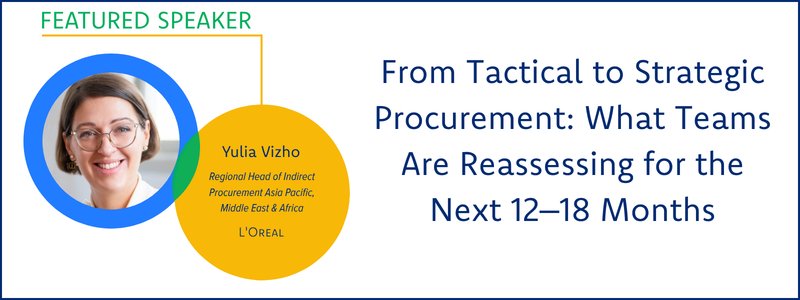
In a recent interview with Yulia Vizho, Regional Head of Indirect Procurement at L'Oréal, one theme came through clearly: this is not a capability gap. It is a prioritisation challenge and here are some of the key shifts procurement teams should be reassessing now.
1. The Shift from Buyers to Orchestrators
The word "buyer" is limiting. It implies a beginning and an end: someone asks, you source, you close. But the next phase of procurement value sits beyond the transaction. It sits in the system behind it.
Take something as simple as a retail display. Traditionally, it is sourced as a unit at the best possible price. Today, it is also:
- A sustainability data point
- A contributor to Scope 3 reduction targets
- A signal that informs future spend and promotional decisions
The transaction still matters, but the intelligence behind it matters more. This shift requires procurement to embed sustainability into sourcing decisions, capture data at the point of execution, and design supplier ecosystems that generate long-term insight. It is a move away from isolated decisions towards interconnected systems where each sourcing activity contributes to a broader understanding of spend, performance, and impact.
"The true value isn't the unit. It's the aggregated data behind our global retail spend."

2. Beyond Cost vs. Growth: The Make-or-Buy Rethink
There was a time when procurement focused on cost, and the business focused on growth. That divide no longer holds. Procurement now sits inside strategic decision-making not outside it. This is most visible in Make-or-Buy decisions.
Old question: "We've decided to outsource. Let's RFP now."
New question: "Where does our unique internal value end, and a partner's specialised capability begin?"
This demands that procurement understands the business's technical roadmap and competitive differentiation—not just its spend. This isn't just signing a contract; it is designing an operating model.
That means aligning vendor incentives with strategic goals and making deliberate choices about what we protect internally and what we hand over. That isn't a sourcing exercise—it is business architecture.
3. Standardise the Backbone. Keep Consumer-Facing Decisions Flexible
Not everything should be standardised. But some things absolutely must be.
We draw a clear line between two types of processes:
- The Backbone: Master Data, P2P, and Compliance. These are standardised regionally and non-negotiably to eliminate manual workarounds.
- The Frontline: What we source and who we source it from. This stays flexible and locally driven
With 5,000+ indirect suppliers across the region, inconsistency in backbone processes isn't a quirk — it's a structural drag. Every manual workaround, every data exception, every non-compliant workflow slows the whole system down.
But beauty is deeply personal. Retail infrastructure and consumer preferences vary enormously by market. The how of our operations is standardised for regional efficiency, while the what and who of our sourcing remains locally flexible to stay relevant to the consumer.
"This is a deliberate strategic choice. Not a compromise."
4. Killing the 'Excel Warrior': Data Integrity Before Scale
Here's the uncomfortable truth: too many procurement teams are still running on files that walk out the door when people do.
Critical sourcing intelligence in spreadsheets. Relationship knowledge is buried in inboxes. Compliance data is scattered across shared drives. This is not just inefficiency, it's a structural risk that determines whether automation accelerates your strategy or simply accelerates your errors.
The pivot must be deliberate: stop fixing data at the end of the process. Enforce it at the source. At L'Oréal, compliance migration was the proof point. We moved contracts and ethical commitment letters entirely into our systems with one unapologetic rule:
"If it isn't in the system, it doesn't exist."

5. The Closing Punch: Stop Trading Strategy for Tactics
Tactical bid management is a misallocation of talent. Full stop.
Saving $10,000 on a line item while missing the opportunity to build a three-year category infrastructure is not a win. It's a choice about where your team's attention goes and it's the wrong choice. Pulling people out of routine bid management is not easy. Some things will drop from the table. That's the point.
You cannot protect everything and move forward at the same time.
Every hour spent on a tactical bid is an hour not spent building the next three years of supplier strategy, capability building, and long-term value creation. Every RFP run out of habit is a category strategy not written. Every manual workaround tolerated is a data problem compounding.
The teams that will lead procurement in 2026 and beyond are the ones making deliberate choices now about where they invest their most valuable resource: the strategic attention of their people.
I know where we create more value. That is where we go.
The Reset Ahead
Procurement is entering a different phase. Less transactional. More strategic. More accountable for outcomes.
The question is no longer: "How do we reduce cost?" It is: "Where do we create value and how do we design for it?" That's the reset now underway.
And it is exactly why conversations like this matter.
Yulia will explore these themes further in her ProcureCon Australia session, From tactical to strategic procurement: What are the practical steps to unlock greater value? For teams trying to move beyond tactical buying, strengthen data foundations, and rethink where procurement effort actually drives impact, this is one of the clearest signals of where the function is heading next.
Download the agenda to see how these priorities are being tackled across the event, or secure your ticket to join the conversation in person at ProcureCon Australia.